
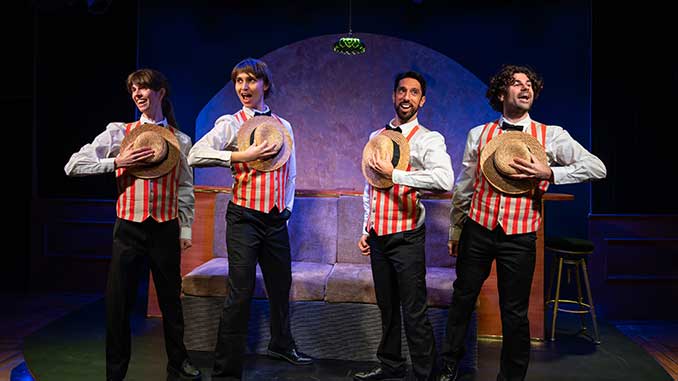
 There is so much going on in Griffin Theatre Company’s new play Afterglow that it should not work, but it does, and that can only be a good thing.
From the pens of two trans creators, Sheanna Parker Russon and Lillian M. Hearne, Afterglow follows the lives of four barbershop quartet singers and their musical accompanist over a period of six years or so, during which each performer finds that their lives have changed for the better, if not each other.
Opening with a typical barbershop four-part harmony, we find that the quartet are competing in the 2012 Barbershop Singing National Championship, while learning to take part on that other barbershop tradition, whisky drinking after practise.
It is during one of these sessions that Michael (Cassie Hamilton) meets the ethereal Tom (Nic Prior), sparking the beginning of a relationship. The other members, Matt (Lincoln Elliott), Rupert (Nat Jobe) and musical director (Lillian M. Hearne) are finding their feet and each other, as they fall into typical banter about boozing and relationships.
As the years progress, so does the relationship between Michael and Tom, only that Tom is questioning everything that is heteronormative, including his own identity. The show develops along a standard plot line of boy meets girl, but everything here is subverted by the gender roles, both as played on stage and in actuality.
 Tom transforms from a male attempting to find his place within the male confines of the barbershop quartet into a gender role that is his own.
With a just a touch of Alexander McQueen tartan and draping he is transformed into a more female version of himself, and so a new phase in their relationship with Michael begins.
Underlying the gender roles that are being questioned by the performers, there is also the question as to why women cannot compete in the barbershop competitions?
About midway through the 75 minute production there is an absolute banger of a tune, Normal, Michael sung by Hamilton, and worthy of any major musical.
Alas, not all of the tunes fair so well, with Prior being difficult to hear when performing at the quieter end of a song, and the quartet do not always reach optimum performance levels across all songs.
One scene written well and performed to the max is the banter about milk, and the different types milk available, such as soya and almond milk, acting as a metaphor for the many ways that people can identify their sexuality.
 The roles of Rupert and Matt are meant to be minor in the production, but in fact both bring colour, humour and a truth to their performances.
Directors Cassie Hamilton and Lily Hayman have worked wonders on this tiny stage, with the single set of a bar and a bench from Geita Goarin subbing for a variety of locations and across time.
As an early member of the quartet who takes on the onstage musical director role behind the keyboards, Lillian M. Hearne accompanies the vocal performances and transitions with taste and creativity.
Tyler Fitzpatrick’s lighting is set for the whole of the stage and does not always take advantage of scene changes, such as when the group retire to the bar for their whisky sessions.
On a limited budget Geita Goarin’s costumes work wonders, from the uniformity of the barbershop outfits to Tom’s wonderful transition outfits and Michael’s final outfit.
Afterglow does not pretend to have all of the answers, but it does have some of the questions surrounding the roles of transgender people and women in a postfeminist world. It does this with a heart and one that will leave you with an afterglow long after the show.
Afterglow
Downstairs Theatre – Belvoir St Theatre, 25 Belvoir Street, Surry Hills
Performance: Tuesday 14 July 2026
Season continues to 25 July 2026
Information and Bookings: www.griffintheatre.com.au
Images: The Cast of Afterglow – photos by Lucy Parakhina
Review: John Moyle